Paper 4 (20%): read a passage aloud fluently (15 marks), then hold a stimulus-based conversation about a photo (25 marks) — about 10 minutes in all, being 5 minutes of preparation and about 5 minutes with the examiners. Paper 3 (10%): 20 MCQ on spoken texts (20 marks, about 35 minutes). Together worth 30% of the total score.
Paper 4 is conducted individually with two examiners. The total time is about 10 minutes (5 minutes preparation, 5 minutes examination). It has two parts that are not linked to each other.
Part 1 — Reading Aloud (15 marks)
Read a short passage aloud to suit the purpose, audience and context. Marked on: pronunciation, clarity, fluency, expressiveness and pace. The passage is given during preparation time.
Part 2 — Stimulus-based Conversation (25 marks)
Discuss a photo with the examiners. Share opinions, personal experiences and ideas. Marked on: relevance, depth of ideas, vocabulary, grammar, fluency and ability to engage.
Part 2 is worth 25 marks — significantly more than Part 1. The stimulus-based conversation is the higher-stakes component and the one where the most marks are available.
Stage 2 of 5 — Reading Aloud
Reading aloud — how to score well
The passage is read to the examiners as if communicating with a real audience — not mumbled, not rushed, not robotic. The five things marked are: pronunciation, clarity, fluency, expressiveness and appropriate pace.
Sample passage (practice reading this aloud):
When the last fishing boat returned to the harbour each evening, old Mr Ng was always waiting. He had stood at the same spot on the jetty for forty years — not to fish, not to sell, but simply to watch. The men who worked the boats knew him well enough to nod, and he would nod back, and that was the entirety of their conversation. Some thought him lonely. He thought himself fortunate.
Listen once, then read it aloud yourself and compare the pauses and stress.
5 techniques for Reading Aloud
1
Pause at punctuation. Commas = short pause. Full stops = longer pause. Dashes and colons = dramatic pause. Do not run through punctuation at the same speed.
2
Stress key words. In "not to fish, not to sell, but simply to watch" — stress "watch" because it is the contrast word. Read the sentence meaning, not just the letters.
3
Vary pitch and pace. Speed up for mundane information, slow down for dramatic or emotional moments. A flat monotone pace scores low on expressiveness.
4
Recover gracefully. If you stumble over a word, simply rewind and speak again clearly, then proceed forward as normal.
5
Use preparation time well. Use at most 2 minutes of the 5-minute preparation, quietly read the passage aloud under your breath. Mark words you find difficult to pronounce. Identify the emotional tone.
Avoid Reading too fast, swallowing word endings, running sentences together, a flat monotone throughout, or skipping words when uncertain of pronunciation (try your best guess instead).
Stage 3 of 5 — Stimulus-based Conversation
How the conversation works — and what marks it
You are shown a photo. The examiners will ask you questions about it — starting with what you see, moving to opinions, and then to your personal experiences and broader ideas. The conversation typically lasts about 3–4 minutes.
What is assessed
Relevance of responses · Range and depth of ideas · Vocabulary range and precision · Grammatical accuracy · Fluency and clarity · Ability to engage naturally with examiners
Common mistakes
One-word answers · Rehearsed-sounding recitations · Refusing to elaborate · Going off-topic · Using "very very" repeatedly instead of precise vocabulary
The golden rule: Say more than you are asked. If the examiner asks "What do you see?", describe the photo fully, then offer an observation or opinion. The examiner's job is to draw you out, and your job is to give them material to work with.
The 3-layer response structure
1
Observe: What do you see? Describe the photo using precise vocabulary.
2
Interpret: What do you think is happening? What might the people be feeling? Why?
3
Connect: Does this remind you of a personal experience? What do you think about the broader issue?
Stage 4 of 5 — Sample conversation
Photo prompt + annotated sample responses
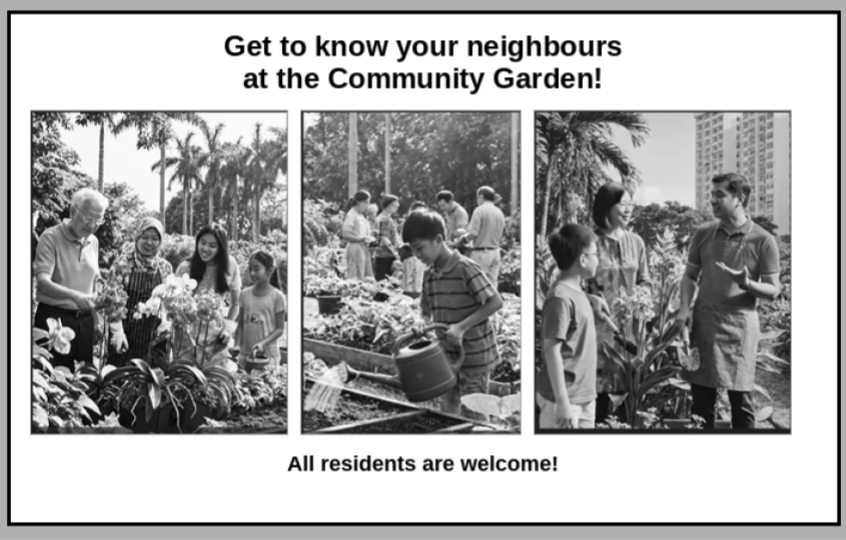
Examiner: "What do you see in this photo?"
Weak answer "I see some people in a garden. They are planting vegetables."
In this photo, I can see people of different ages coming together in a community garden. You can even spot some HDB flats in the background.
In one scene, an elderly man and a woman are looking at some flowers with a young girl. They seem to be sharing their knowledge about the plants with her, and the girl looks genuinely interested and happy to be there.
In another scene, a boy is watering a raised garden bed with a watering can, while other people tend to plants in the background. Everyone seems focused and engaged in what they're doing.
Overall, the photo shows people across different generations bonding over gardening. It gives me the impression that community gardening isn't just about growing plants. It's also about passing down skills and spending meaningful time together.
Works through the photo scene by scene instead of describing it all at once, and notices background detail (the HDB flats). Reads how people feel, not just what they are doing ("genuinely interested," "focused and engaged"). Ends by stepping back to say what the photo means.
Examiner: "Why do you think people of different ages are gardening together here?"
Weak answer "Because it is fun to garden together."
I think there are a few reasons why people of different ages might garden together like this.
For the older generation, sharing gardening knowledge with younger ones is a way of passing down a skill that might otherwise be lost. It probably also gives them a sense of purpose — knowing that what they know still matters.
For the children, being guided by someone more experienced makes learning much more hands-on and meaningful than just reading about it in a book.
But I think beyond just the gardening itself, it's really about connection. When you work on something together, you naturally start talking, laughing, and building a relationship. So community gardens like this one serve a bigger purpose. They're not just growing plants, they're growing relationships too.
Signposts the structure ("a few reasons"), then takes each side in turn — what the older generation gains, what the children gain — before widening out. "Sense of purpose," "hands-on," "connection" are precise words. Closes on a memorable line rather than trailing off.
Examiner: "Have you ever done something like this with people of different ages?"
Yes, though not gardening specifically. When I was younger, my grandmother used to bring me into the kitchen whenever she was making pineapple tarts, and my job was usually to help with the shaping, a simple step she trusted me with.
What struck me was how she never used a recipe. Everything was by feel — a handful of this, a pinch of that. When I asked her how she knew it was enough, she just smiled and said "you'll know when you've done it enough times." That stayed with me, and made me realise that some knowledge only gets passed on when you're standing right next to someone who has it.
Looking back, I think those afternoons in the kitchen were her way of keeping me connected to something bigger than just the food itself — our family traditions, our culture. And I'm glad I didn't say no when she asked, because she's no longer around to teach me anymore.
Answers honestly rather than forcing a gardening story ("Yes, though not gardening specifically"), then earns marks with specifics: pineapple tarts, the shaping step, her actual words. One small memory is turned into a point about how knowledge is passed on — personal, but not rehearsed.
Stage 5 of 5 — Preparation & common mistakes
10 habits that raise your oral score
1
Always elaborate. Never give a one-sentence answer to a conversation question. Add a reason, an example, or a personal connection every time.
2
Use precise vocabulary. Replace "nice," "good," "bad," "very" with specific words: "heartwarming," "meaningful," "challenging," "remarkably." This directly raises your language score.
3
Give your opinion. Examiners want to know what you think, not just what you observe. After describing a photo, add: "I think," "In my opinion," "It seems to me that..."
4
Acknowledge complexity. Show mature thinking: "While some people might feel... I personally think... because..." This demonstrates evaluative thinking, not just description.
5
Use examples from your life. Personal anecdotes make your responses specific and credible. Generic answers ("I think teamwork is important") score lower than specific ones ("When my class prepared for Sports Day last year...").
6
Speak at a comfortable pace. Many students rush. Slowing down improves clarity, gives you time to think, and sounds more confident. Pausing briefly to collect your thoughts is better than filler sounds ("um," "like," "you know").
7
Make eye contact with the examiners. The oral is a conversation — look at the examiner who asked the question. Staring at the table the whole time reduces your communication score.
8
Do not memorise answers. Practise thinking through a range of topics (family, community, technology, environment, school, health) so you can respond naturally to any photo. Memorised answers sound unnatural and break down under follow-up questions.
9
Ask for clarification if needed. If you don't understand a question, say "Could you please rephrase that?" — this is better than guessing and going off-topic.
10
End your answers naturally. Signal when you have finished: "...and that is why I feel community activities like this are important." Trailing off leaves the examiner unsure whether to follow up.